

Broken sequence
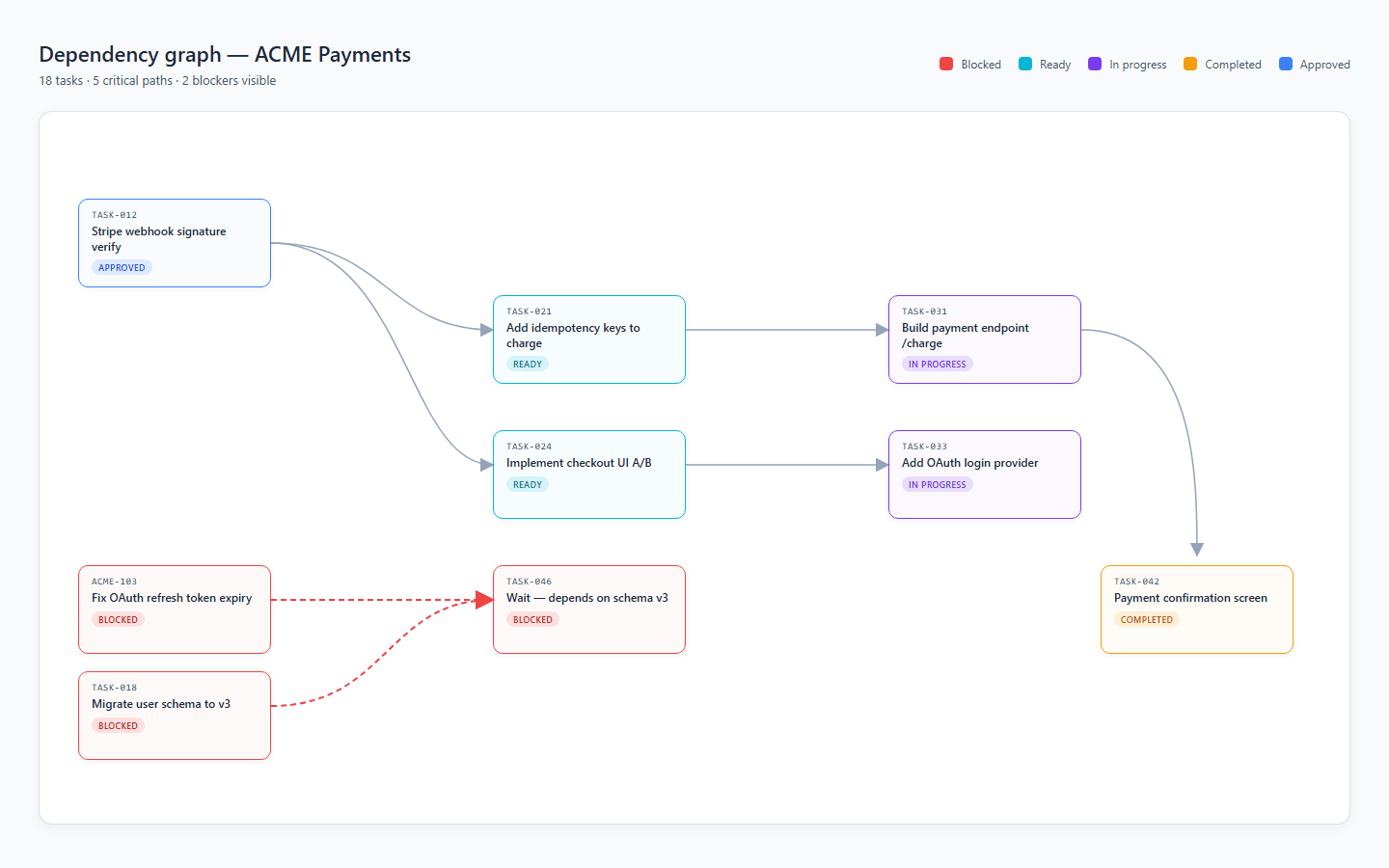
Tasks start before their inputs exist. An agent builds a frontend component against an API that hasn't been written yet. The result: rework, wasted compute, and a reviewer who has to untangle it.

The control plane for agentic software delivery.
Plan work, route tasks to specialized AI agents, enforce human approvals, and know what is actually ready to release.
Your team runs multiple coding agents in parallel. Execution got faster — but nobody is governing the handoffs, the sequencing, or the difference between "done" and "shippable."
Tasks start before their inputs exist. An agent builds a frontend component against an API that hasn't been written yet. The result: rework, wasted compute, and a reviewer who has to untangle it.
Agent work lands across terminals, PR threads, chat messages, and ticket updates — simultaneously. Assembling what actually changed in a sprint means checking five places and hoping nothing slipped through.
An agent completes a change and the system marks it done. But no one with context reviewed the output. Code reaches staging without a human confirming it does what it should.
The agent says finished. The board says complete. But has it been reviewed? Approved? Tested against the current branch? Most teams can't distinguish an agent's output from a verified deliverable.
It's not just your team.
of developers distrust the accuracy of AI-tool outputs.
— Stack Overflow Developer Survey, 2025
of companies report a mature governance model for autonomous agents.
— Deloitte, 2026
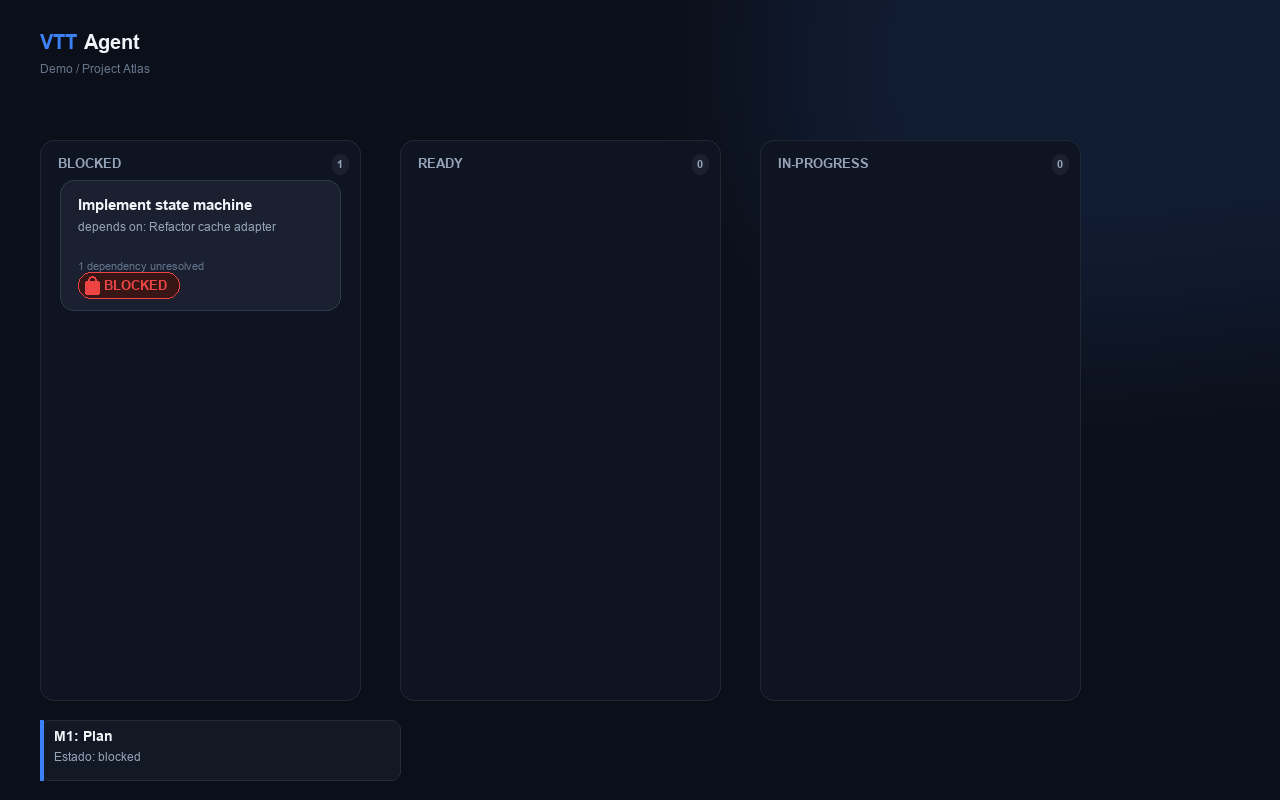
The problem isn't task management — it's execution eligibility. VTT Agent maintains a decision model that evaluates what work can start right now without breaking what comes after. A task might be blocked by a technical output that doesn't exist yet, by a phase gate, or by an approval that hasn't happened — and each type of block has different rules.
The "Execution Queue" is separated from the plan. A task can exist in the plan without being executable. It can be completed without being approved. And it can be approved without being release-ready. These are three distinct states with three distinct gates — not three labels in a dropdown.

Each task runs in an isolated container with its own branch, filesystem, and permissions. When the task finishes — or fails — the container is destroyed. No shared state between agents.
Every agent operates under scoped permissions defined per task. Access to critical files — authentication, database schemas, deployment configs — automatically raises the risk level and requires human review.
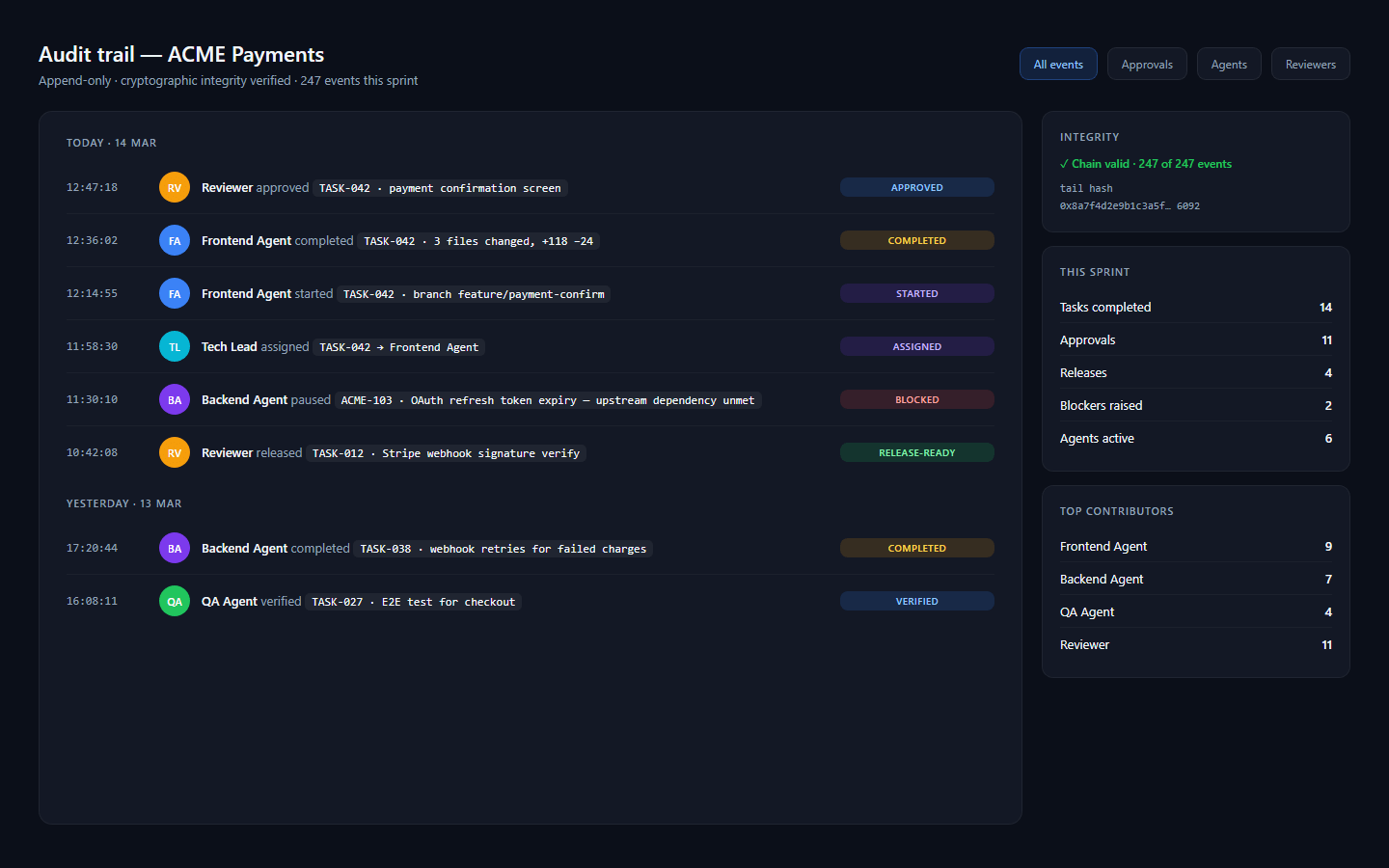
Every assignment, execution, review, and approval is recorded with cryptographic integrity verification. The record is append-only — entries cannot be modified or deleted after the fact.
The system monitors eight signals during every execution: timeouts, budget thresholds, error rates, output corruption, loop detection, scope creep, security violations, and external dependency failures. Any trigger pauses execution and preserves partial work.

Built for teams already using Cursor, Claude Code, and Codex.
VTT Agent works with the repositories, coding agents, CI/CD pipelines, and issue trackers your team already runs. You don't migrate — you add a coordination layer that governs how work flows between them.
Status reflects actual integration progress. We don't ship logos we haven't built.
How do I know what agents did and what needs my review?
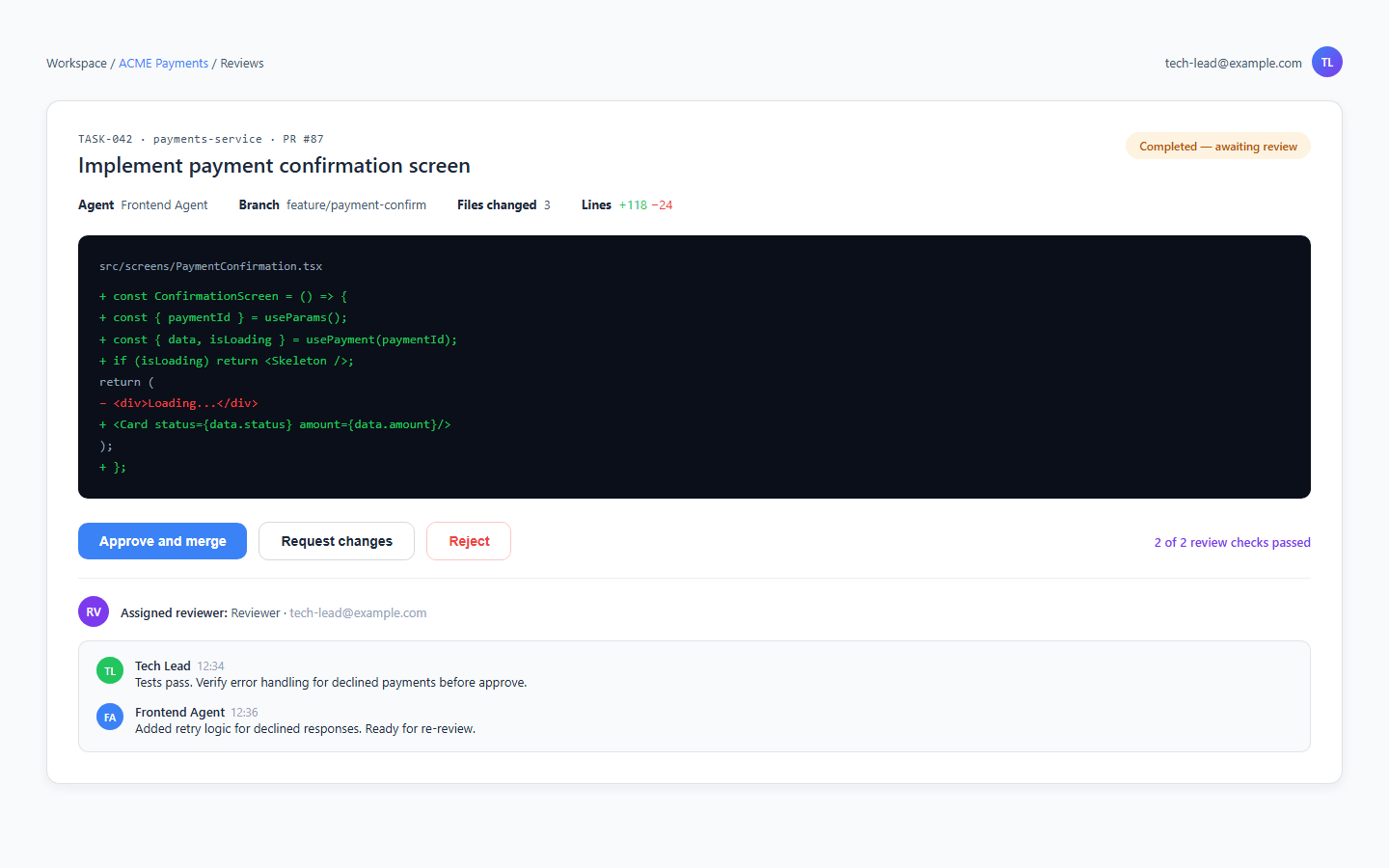
An execution queue shows what's running, what's waiting for review, and what's been approved. Every agent output has a clear status — completed, approved, or release-ready — with an explicit approval gate between each state. You review what matters, skip what passed automated checks, and know exactly what's ready to ship.
Early access isn't a waitlist. It's a seat in the room where we define templates, integration priorities, and approval workflows. Your team's operational reality shapes what ships.


Integrations ecosystem
Human approval required
Every agent output is reviewed by a human before it advances. No self-approvals.
Sandboxed execution
Agents work in isolated containers with scoped permissions. No shared state, no side effects.
Full audit trail
Every action, assignment, and approval is recorded and verifiable.